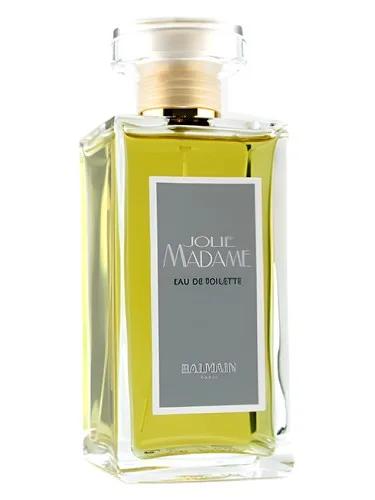
Jolie Madame
Jolie Madame opens with a bite of green petitgrain and neroli that barely softens the flowers to come.

The scent fingerprint
Weighted by intensity across 17 accords.
Every perfume in Sillage is represented as a distribution across canonical accord slugs — a lingua franca for scent. Two fragrances with overlapping fingerprints are scent-twins, even if they share no literal note.
- Leather60
- Tuberose55
- Mossy55
- Herbal
The note pyramid
- Gardenia
- Petitgrain
- Neroli
- Bergamot
- Tuberose
- Violet Leaf
- Jasmine
By the editors · 2 min readJolie Madame opens with a bite of green petitgrain and neroli that barely softens the flowers to come. The white blossoms—gardenia, tuberose, jasmine—aren't powdered or sweetened but shadowed by violet leaf's metallic edge and a dry, almost astringent quality that keeps them from blooming too openly. This is formality with an undertow.
As it settles, the leather emerges, supple and animalic, reinforced by civet and oakmoss in their unreconstructed form. The base is earthy rather than polished: tobacco, vetiver, patchouli, all grounding the florals into something more like worn gloves than a corsage. There's an unexpected whisper of coconut that adds warmth without sweetness.
The overall effect is reserved elegance with a feral streak—a perfume for someone who knows the difference between manners and meekness. It belongs to the era when chypres were built like architecture, not atmospheres.
Scent twins
Factual metadata (name, house, year, notes) is seeded from public datasets. The editorial reading and scent fingerprint are written by Claude against our house style — none of it is scraped prose. Read our methodology.