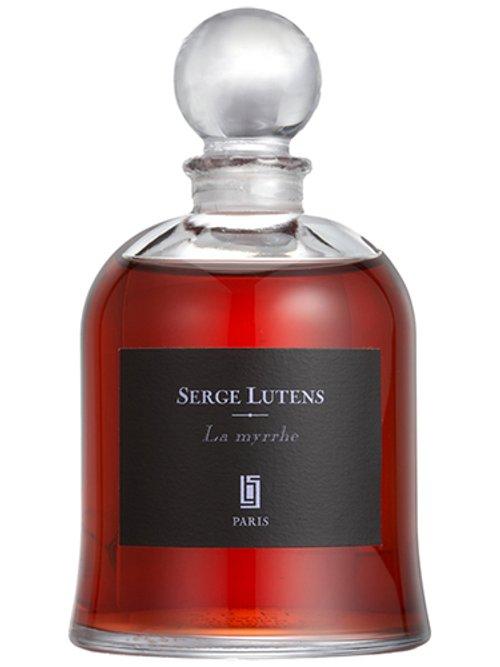
La Myrrhe
La Myrrhe opens with a burst of bright mandarin that quickly dissolves into the dense, resinous heart of myrrh—not the cleaned-up kind, but something darker, almost medicinal.
The scent fingerprint
Weighted by intensity across 13 accords.
Every perfume in Sillage is represented as a distribution across canonical accord slugs — a lingua franca for scent. Two fragrances with overlapping fingerprints are scent-twins, even if they share no literal note.
- Smoky80
- Woody75
- Amber60
- Honey
The note pyramid
- Sandalwood
- Myrrh
- Jasmine
- Amber
- Mandarin
- Musk
By the editors · 2 min readLa Myrrhe opens with a burst of bright mandarin that quickly dissolves into the dense, resinous heart of myrrh—not the cleaned-up kind, but something darker, almost medicinal. There's an immediate weight to it, a kind of solemn opacity that feels both ancient and deliberate. The jasmine adds a surprising floral sweetness that keeps it from becoming too severe, though this is hardly a flower shop composition.
As it settles, sandalwood and amber create a warm, skin-close base that softens the initial austerity. The musk provides gentle tenacity without overwhelming the central myrrh theme, which remains present throughout. This is a fragrance that conjures incense-filled spaces and quiet contemplation rather than anything overtly seductive.
La Myrrhe suits those who appreciate minimalism with depth—people comfortable with fragrances that feel more like rituals than accessories. It's introspective rather than gregarious, worn for yourself rather than a room.
Recent coverage
- other · The Perfume Room · Apr 28, 2026
209. CALICE BECKER (Givaudan Master Perfumer) ~ The Perfumery School Harder to Get Into Than Harvard.
PERFUME ROOM CANON ALERT! Givaudan Master Perfumer Calice Becker is shaping the future of perfumery at every level. Not only have her iconic creations like Tommy Girl, J'Adore Dior, Love Don't Be Shy, and Velvet Orchid (to name just a few) come to define entire decades of perfum
- other · Grain de Musc · Mar 8, 2023
Aurélien par Aurélien Guichard pour Carine Roitfeld: le miroir noir d'Opium
Ce parfum, vous avez l’impression de le reconnaître, vous avez son nom sur le bout de la langue... Autant la donner au chat, sauf à avoir, un soir, croisé le sillage de Carine Roitfeld. Car l’ex-rédactrice en chef de Vogue France avoue avoir longtemps superposé Opium d’Yves Saint
Scent twins

Factual metadata (name, house, year, notes) is seeded from public datasets. The editorial reading and scent fingerprint are written by Claude against our house style — none of it is scraped prose. Read our methodology.